What I didn’t know when I rolled into Glen Innes was how familiar this small town would feel.
From about ten kilometres outside its boundary, I felt an ancestral echo I can only describe as familiar — organic, internal. Strange, but something I won’t forget soon.
Before arriving, I didn’t know Glen Innes is the location of the annual Australian Celtic Festival. Nor did I know that for many decades this area has been home to those with strong Celtic roots.
My fellow traveller, Sandra, suggested I visit the Standing Stones. Given the Australian tendency to get excitable about two rocks balanced together, I assumed they were merely a small monument erected to some long-forgotten historical event.
I was so wrong.
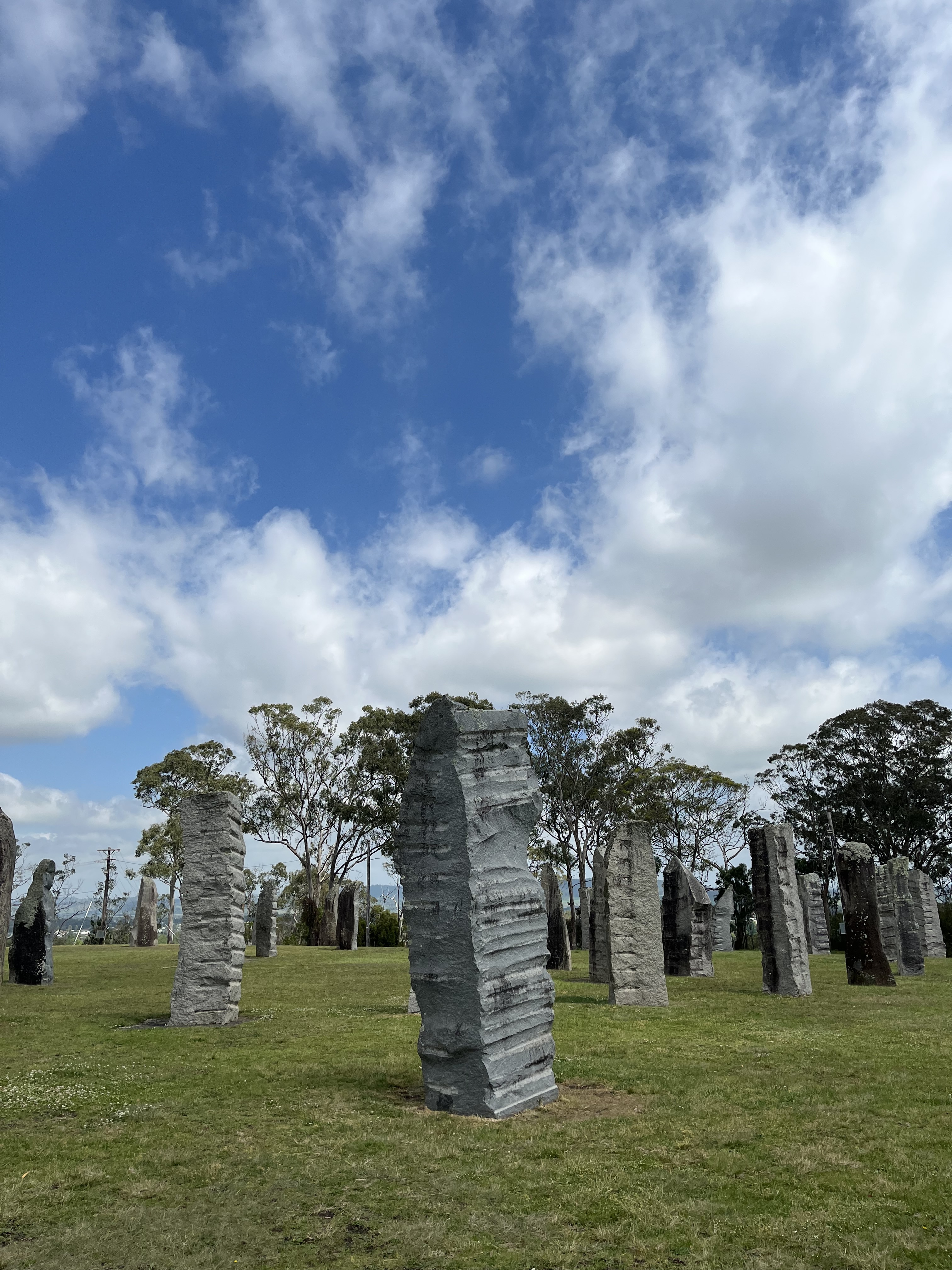
In 1991–1992, a series of stones was erected at the top of a hill in Glen Innes. It is, essentially, a tribute and recognition of the contributions made by those from Celtic lands to the culture of Glen Innes — and to Australia more broadly.
Spread over a large area, the Stonehenge lookalike (minus the crossing stones) was still worth the trek.
I read with amusement about the day the first stone was hauled into place — how the tug-of-war team pulled it upright after emblems from each of the Celtic regions were dropped into the excavation hole:
- Thistle for Scotland
- Shamrock for Ireland
- Leek and daffodil for Wales
- Primrose for Cornwall
- Broom for Brittany
- Ragwort for the Isle of Man
- And for Australia, a wattle
Plus a sprig of rowan, known as an ancient Celtic symbol.
After the emblems were dropped in, a priest was asked to pour whisky over the nestled items. He was heard to mutter, “For shame to be so wasteful. It should have been filtered through the kidneys first!”
Visiting the Standing Stones — each at least two metres in height — was more stimulating, more educational, than my arrogance had foreshadowed.
For once, the Australian tendency for excitability was a measured response to something special — something my forebears were likely part of in some ghostly way.
And that ghostly echo reasserted itself on the day I left Glen Innes to travel to my father’s birthplace, Tenterfield.
As I crossed the bridge near the free camp that had become home during my short stay, waves of grief crashed through me. But they were faint — like echoes of sorrow not felt in real time.
Had my ancestors experienced grief here?
Or was my leaving Glen Innes a through-line to The Clearing that took place in the Scottish Highlands centuries ago?
Loss that wasn’t mine hummed through every nerve, making it impossible not to weep deep, racking sobs. But prior to arriving, I’d never visited Glen Innes before.
Even now, I shrug with dismay.
I know what I felt.
I don’t understand it.
But perhaps it is enough for my forebears to know that I witnessed their sorrow.

 Christine Writer